By Lani Guinier
Lift Every Voice : Turning a Civil Rights Setback into a New Vision of Social Justice
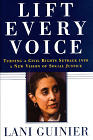 Lift Every Voice (Simon and Schuster, 1998) takes readers behind the closed doors of the Oval Office, the Justice Department and the U.S. Senate with an insiders account of one of Bill Clintons most controversial nominations. Lani Guiniers thought provoking ideas about representative democracy were grossly distorted and mischaracterized in a successful effort to derail her nomination to be Assistant Attorney General for Civil Rights in 1993. The low-tech lynching she experienced forms the backdrop for Prof. Guiniers insightful look at how President Clinton abandoned his ambitious civil rights agenda in the face of heated criticism and how the civil rights movement suffered a major setback as a result. The book is more than a memoir, however, and honors the efforts of the foot soldiers of the civil rights movement the men and women who believe fervently in the promise of democracy and act on that belief every day of their lives. Prof. Guinier also shows by her example, how the leaders of the civil rights movement are often silenced by the very people they should be challenging. Finally, she explains the ideas that were at the heart of the controversy, examines the state of race relations, and calls for a national conversation to reframe issues of civil rights and social justice.
Becoming Gentlemen: Women, Law School, and Institutional Change
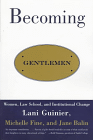 In Becoming Gentlemen (Beacon Press, 1997), Lani Guinier, then a professor of law at the University of Pennsylvania, along with co-authors Michelle Fine, professor of social psychology at the Graduate School and University Center, City University of New York; and Jane Balin, assistant professor of sociology at Colgate University unveil a thought-provoking thesis about the pressure put on women in law school to conform to a rigid standard and learning model in order to succeed. The title is taken from a comment made by a male colleague to a first year class, To be a good lawyer, behave like gentlemen.
In essays supported by research and first-person narratives, the authors explore how turning women into gentlemen can engender a sense of alienation and undermine individual development and performance. Professor Guinier also draws upon her own Alice in Wonderland-like experience as President Clintons nominee for Assistant Attorney General for Civil Rights to describe the effects of having ones identity and voice distorted in a hostile environment.
The Tyranny of the Majority :Fundamental Fairness in Representative Democracy
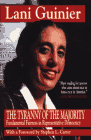 President Clintons 1993 nomination of Lani Guinier to head the justice departments civil rights enforcement efforts ignited a firestorm that thrust the political scholar and law professor into the harsh glare of the national spotlight. At the heart of the controversy were misinterpretations of Prof. Guiniers writings on democracy, political equality and majority rule. The Tyranny of the Majority (The Free Press, 1994) is a compilation of the articles that provoked the fierce opposition of Clintons enemies.
As Prof. Guinier points out in the opening essay, the potential tyranny of majority rule was of major concern to those who founded this republic. She takes that concern a few steps further and explores positive-sum, taking turns solutions for when majority rule is patently unfair to those in the minority. Along the way, she challenges the civil rights movement to progress beyond its tried and true tactics, including its focus on the numbers of elected black officials and proposes ways to rejuvenate the political system to give voters reasons to participate.
Colleges Should Take 'Confirmative Action' in Admissions
by Lani Guinier
A Modest Proposal for Voter Empowerment
Lani Guinier finds that South Africa, only six years out of apartheid, is more advanced in terms of practicing democratic principles than the United States 150 years after slavery and challenges us to reckon with the fact that nationally, 14 % of African American men do not have the right to vote, yet they are still counted to boost the political clout of rural while legislators. Go there now&or to the PDF version.
Confirmative Action
At the dawn of a new millennium, Americas quest to overcome the effects of centuries of racial inequality is on a collision course with its even more pervasive preoccupation with technology of all kinds, particularly quantifiable measurements of that all-American social good, success. Go there now.... of to the PDF version.
Leadership from the Bottom Up
While campaigning for the presidency, Texas Governor George W. Bush frequently touted the states successful 10 percent plan as a model of inclusion and an example of his leadership in education reform. Lani Guinier and Gerald Torres argue, however, that rather than lead, Bush just got out of the way. Go there now&or to the PDF version.
Making Every Vote Count
For years many of us have called for a national conversation about what it means to be a multiracial democracy. We have enumerated the glaring flaws inherent in our winner-take-all form of voting, which has produced a steady decline in voter participation, under representation of racial minorities in office, lack of meaningful competition and choice in most elections and the general failure of politics to mobilize, inform and inspire half the eligible electorate. Go there now... or to the PDF version.
The Ballot, Via the Courthouse
CAMBRIDGE,Mass. What began as judicial overreaching may be a clarion call for major democratic reform. Some legal experts already argue that last week's United States Supreme Court decision, though heavily criticized for deciding an election, could help open the local courthouse doors to election reform. Go there now... or to the PDF version.
What We Must Overcome
On December 12, 2000, in Bush v. Gore, the Supreme Court selected the next president when, in the name of George Bush's rights to equal protection of the laws, it stopped the recounting of votes. The Courts decision and the colossal legal fight that preceded it put the values, and not just the mechanics, of American democracy front and center. Excoriated at the time for deciding an election, the Courts stout reading of equal protection could nevertheless become an invitation, not just to future litigation but also to a citizens movement for genuine participatory democracy. At minimum, the Courts surprising and heavy-handed intervention should now spark a real debate about the rules of democracy on an even larger scale than we previously imagined. Go there now ..... or to the PDF version.
MBTA Must Stop Harassing Black Kids
THE MBTA HAS zero tolerance for laughing. If you are caught laughing out loud at or near an MBTA stop, you can be arrested and charged with disorderly conduct. Zero tolerance means no laughing, no running, and not even minding your own business while waiting for a bus. Go there now ..... or to the PDF version.